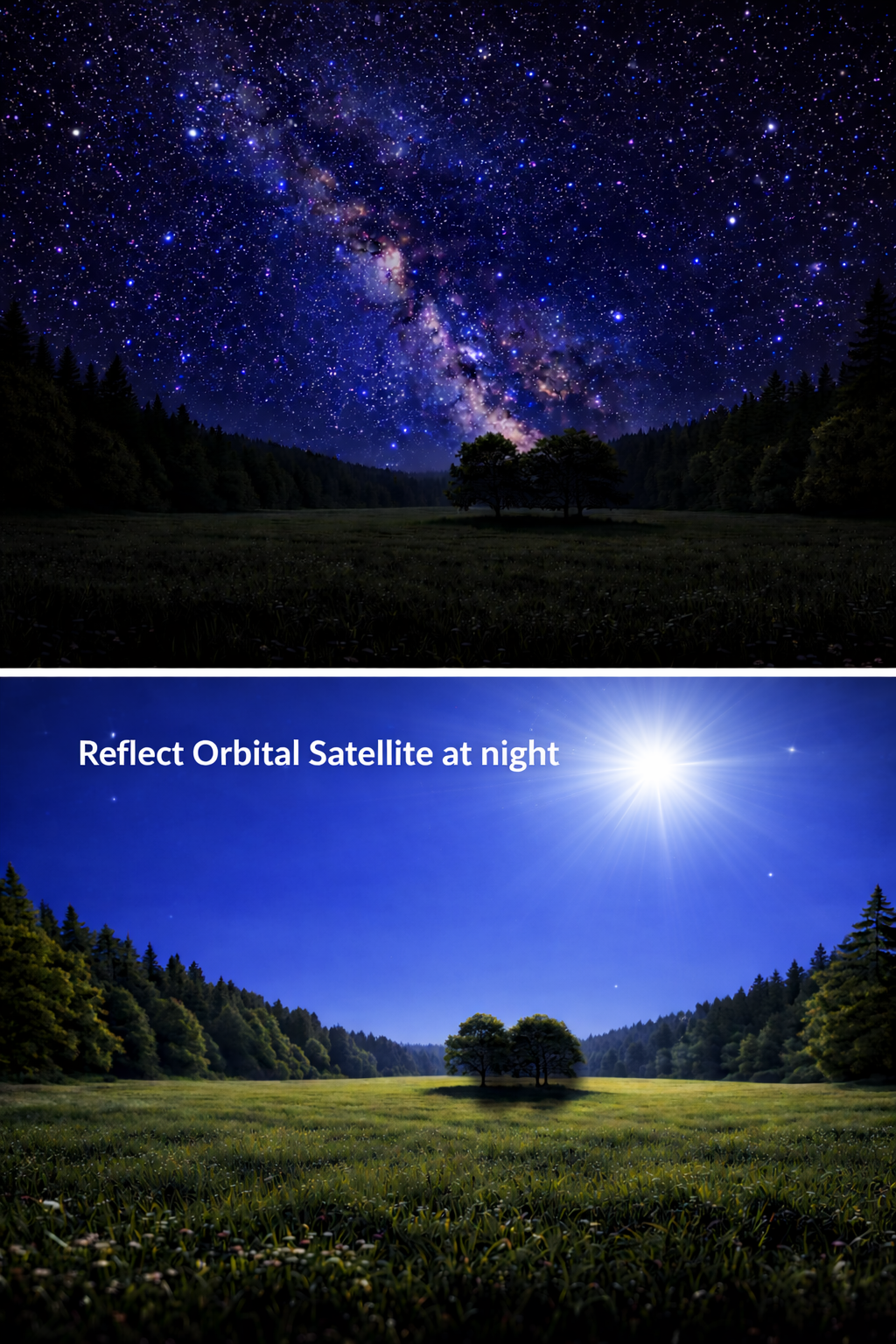
 Pristine night sky with the Milky Way
 Same nightscape with a Reflect Orbital satellite
What is Reflect Orbital?
Reflect Orbital is a company proposing a constellation of Earth orbiting satellites (50,000 by 2035!) to provide a sunlight-on-demand service to consumers. This would involve reflecting beams of sunlight with ~5 km in diameter onto Earth's surface to provide lighting/energy to the customer. The satellites will have a devastating effect on our night time environment and will wipe out the view of the night sky.
They claim that this infrastructure provides a source of clean energy and lighting that will have positive effects, such as boosting solar farm production and agricultural yields, creating safer working conditions, and reducing ground-based light pollution.
They also claim that the beams a) will be highly localized, b) can “avoid sensitive areas like research observatories or protected habitats”, and c) will not harm eyes, “even when viewed through a telescope”.
We are skeptical of all of these points, as explained below, and we are very concerned about the many harmful effects this constellation of satellites would have.
We need your help. Here is how you can take action:
Take ActionWhy This Matters
- Adverse impact on human health by disrupting circadian rhythms.
- Disruption of the flora and fauna at night; ethology, migration, hunting, hiding, etc. Wildlife cannot adapt to a major, sudden departure from the existing rhythm of day/night cycles in a given area.
- Further degradation of the night sky for the public due to increased skyglow and light pollution.
- Potential safety hazards for aviation, from bright glints as the beams turn on and off, or to airplanes when they fly through the floodlit zones.
- The impact on dark sky protection and astronomical observations.
- The environmental impact of launching 50,000 satellites, including from rocket launches, satellite de-orbiting, and the associated orbital debris.
Additional Remarks
- Everyone within the 5km-diameter spots will be affected. Light will fall on anything with the circle of illumination - on your roof, backyard, local forest, and beyond. This is exactly the opposite of responsible outdoor lighting.
- Rayleigh scattering in the atmosphere, both from the incoming beam and from reflected light, is ignored by the company, and results in an enormous skyglow from a brightly illuminated area the size of 650 football stadiums. This technology will introduce sustained artificial dusk and dawn conditions across landscapes, in addition to hours-long bursts of daytime brightness.
- Paradoxically, "clean energy" is used here to cause environmental damage. (What if we used wind-power to drive oil wells or solar panels to charge coal-mining trucks?)
- Currently, at least 75% of nighttime lighting on Earth is wasted through overlighting, trespass, and uplight. The largest positive impact on our environment would come from eliminating this 75%.
FCC Public Comment Period
Reflect Orbital has submitted an application to the Federal Communications Commission (FCC) to launch a testing satellite, EARENDIL-1. Their demonstration satellite would produce a beam about as bright as the full Moon, while the full constellation could produce illumination comparable to that of the Sun at high noon.
The FCC has opened a public comment period until March 9th, 2026, giving the public an opportunity to voice their thoughts and concerns about federally approved projects.
As it stands, there are barely any comments, and their proposal will sail through the FCC.
Take Action
We have three asks of you:
Sign the DarkSky Open Letter
Sign and share the open letter opposing this project, written by DarkSky International.
Their statement and the place to sign are available here. Signing takes less than 30 seconds and only requires you to enter your name and email address.
Sign the Petition
Sign and share this petition advocating against Reflect Orbital.
This also only requires you to enter your name and email, and takes another half a minute.
Submit an FCC Comment
Please consider submitting a public comment to the FCC by March 9th. There are a few steps to do this, which we have tried to make as easy as possible for others to replicate:
- Copy and fill in a template public comment if you do not want to write your own. We have written one you can use (attached), or DarkSky International has one here. If possible, personalize the comment to increase its impact.
- Create an FCC User account (you just need to enter your name and email, choose a password, and select a security question). This is a bit of a hassle, but that is partly why the FCC has so few comments opposing this project. Please fight through!
- To submit the public comment, find instructions here by AAS, which includes screenshots of navigating the FCC website, or here by DarkSky (using "Reflect Orbital proposal: SAT-LOA-20250701-00129").
Links & Resources
External Links
- Reflect Orbital Website The company's official site
- YouTube: David Kipping “Stop the Dumbest Mega Constellation” Short YouTube video
- DarkSky International Statement Sign the open letter opposing Reflect Orbital
- Change.org Petition "Stop space mirrors! Protect the night sky"
- Create an FCC User Account Required to submit a public comment
- AAS: How to Submit FCC Comments Step-by-step instructions with screenshots
- DarkSky: How to Submit FCC Comments Alternative instructions from DarkSky International
Downloadable Documents
- IAU Letter to the FCC Regarding Reflect Orbital PDF
- DarkSky Open Letter to Reflect Orbital PDF
- Deflect Orbital (Bakos) PDF
- Reflect Orbital Fact Sheet PDF
- DarkSky Southern Arizona Statement PDF
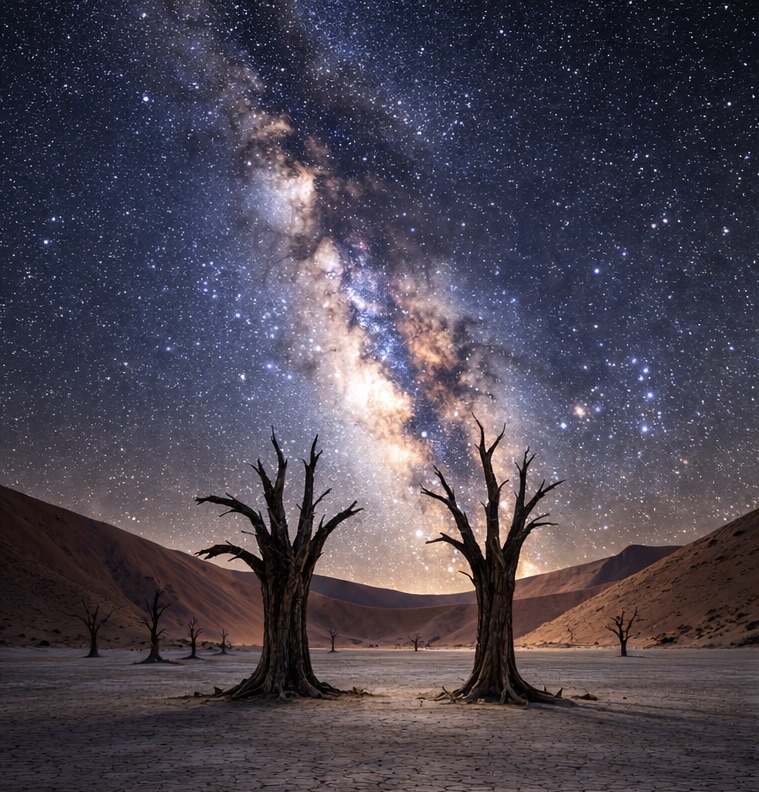
- Namibia Writeup PDF, impact analysis
- Public Comment Template DOCX, customizable template for your FCC submission
- DarkSky Public Comment Template DOCX, alternative template from DarkSky International
Simulated Visual Renderings